Quantum computing promises to solve problems classical machines never could. Yet for years, progress felt painfully slow, with error rates and qubit instability blocking real-world applications. The latest breakthroughs in quantum computing 2024 shattered that ceiling, delivering tangible hardware milestones and software advances that demand your attention right now.
What Are the Latest Breakthroughs in Quantum Computing 2024?
This year marked a turning point for the entire quantum industry. Research teams at IBM, Google, and Microsoft each published results that moved quantum systems closer to practical, everyday use.
The latest breakthroughs in quantum computing 2024 span three major areas: qubit count expansion, error correction reliability, and new processor architectures. Each of these achievements solves a specific problem that previously held the field back.
Here is a quick snapshot of what changed:
- Qubit counts crossed the 1,000-qubit barrier for the first time in a usable system
- Error correction reached below-threshold performance on real hardware
- Topological qubits moved from theory to early physical demonstration
- Quantum networking achieved longer-distance entanglement than ever before
These milestones matter because they shift quantum computing from a laboratory curiosity to a technology with a clear commercial timeline.
How Did IBM Push Qubit Counts Past 1,000 in 2024?
IBM released its Condor processor, packing 1,121 superconducting qubits onto a single chip. This number alone does not guarantee useful computation, but it proves that fabrication techniques can scale.
The company paired Condor with its Heron processor, which focuses on quality over quantity. Heron uses 133 qubits but achieves significantly lower error rates per gate operation.
IBM’s strategy shows a split approach. High qubit counts demonstrate manufacturing capability, while lower-count, higher-quality chips handle actual workloads. Both paths feed directly into the latest breakthroughs in quantum computing 2024 and set the stage for fault-tolerant systems.
Why Does Quantum Error Correction Matter More Than Ever?
Qubits lose their quantum state quickly. Heat, vibration, and electromagnetic noise all cause errors that ruin calculations. Without reliable error correction, no quantum computer can run long enough to solve meaningful problems.
In 2024, Google’s quantum AI team demonstrated that adding more physical qubits to a logical qubit actually reduced the overall error rate. This result, published in Nature, confirmed a long-standing theoretical prediction for the first time on real hardware (Nature, 2024).
This achievement stands as one of the most significant among the latest breakthroughs in quantum computing 2024. It tells engineers that building bigger error-corrected systems will genuinely improve performance rather than introduce more noise.
What Did Google Achieve With Its Willow Quantum Chip?
Google unveiled its Willow chip in late 2024, featuring 105 qubits with dramatically improved coherence times. The chip performed a specific benchmark calculation in under five minutes that would take the fastest classical supercomputer roughly 10 septillion years.
That number sounds absurd, and it is. The benchmark itself does not solve a practical problem. But it proves that quantum hardware can outpace classical machines on tasks that grow exponentially harder.
Google’s results directly support the narrative behind the latest breakthroughs in quantum computing 2024. The company showed that error rates drop as qubit arrays grow, which reverses a trend that worried researchers for years.
How Are Topological Qubits Changing the Hardware Race?
Most quantum computers today use superconducting circuits or trapped ions. Both approaches work, but both struggle with noise. Topological qubits take a different path by encoding information in the physical properties of exotic particles called Majorana zero modes.
Microsoft announced in 2024 that its team created and controlled Majorana-based qubits in a lab setting. The qubits showed inherent resistance to local noise, meaning they could maintain their state longer without heavy error correction overhead.
This development adds a new dimension to the latest breakthroughs in quantum computing 2024. If topological qubits scale, they could reduce the number of physical qubits needed for a single logical qubit from thousands to dozens.
Which Industries Benefit Most From Quantum Advances in 2024?
Quantum computing does not help every task. It excels at problems involving massive combinatorial searches, molecular simulations, and complex optimization. The industries closest to seeing real benefits include:
- Pharmaceuticals: Simulating molecular interactions to speed up drug candidate screening
- Finance: Running Monte Carlo simulations for risk modeling at unprecedented speed
- Logistics: Optimizing supply chain routes across thousands of variables
- Materials science: Designing new battery compounds and superconductors at the atomic level
- Cybersecurity: Preparing for post-quantum encryption standards
Each of these sectors already runs pilot programs with cloud-based quantum services from IBM Quantum, Amazon Braket, and Azure Quantum.
What Role Do Quantum Algorithms Play in Drug Discovery?
Classical computers approximate molecular behavior. Quantum computers can simulate it directly because molecules themselves obey quantum mechanics. This alignment makes drug discovery one of the most promising applications tied to the latest breakthroughs in quantum computing 2024.
In 2024, researchers used variational quantum eigensolver (VQE) algorithms to model the electronic structure of small protein fragments with higher accuracy than classical density functional theory methods.
The results remain early-stage. Current quantum hardware cannot yet simulate full drug molecules. But the trajectory is clear, and pharmaceutical companies like Roche and Biogen have increased their quantum research budgets accordingly.
How Close Are We to Practical Quantum Advantage?
A quantum computer has a quantum advantage if it can solve a real-world problem more quickly or affordably than any classical counterpart.As of 2024, the field has achieved quantum supremacy on narrow benchmarks but has not yet crossed into broad commercial advantage.
Most experts working in the field estimate that practical quantum advantage for specific industrial tasks will arrive between 2027 and 2030. The latest breakthroughs in quantum computing 2024 accelerated that timeline by roughly one to two years compared to projections made in 2022.
Key milestones still needed include:
- Logical qubit counts above 100 with sustained coherence
- Quantum memory that stores states for hours rather than microseconds
- Software stacks that let non-physicists write quantum programs easily
What Did Microsoft Contribute to Quantum Computing in 2024?
Microsoft focused on two fronts: topological hardware and cloud software. Its Azure Quantum platform expanded to offer hybrid classical-quantum workflows that let developers test algorithms on simulated and real quantum backends side by side.
On the hardware side, the Majorana qubit demonstration grabbed headlines. Microsoft also released an updated quantum development kit (QDK) that simplifies error correction implementation for third-party researchers.
These contributions round out the latest breakthroughs in quantum computing 2024 by addressing the software gap. Hardware means little without accessible tools that let a broader developer community experiment and build.
How Does Quantum Networking Progress Look This Year?
Quantum networking aims to transmit entangled qubits across long distances, forming the backbone of a future quantum internet. In 2024, a team at Delft University of Technology successfully entangled qubits across a 1.2-kilometer fiber optic link with record fidelity.
China’s Micius satellite program also reported improved entanglement distribution rates between ground stations separated by over 1,200 kilometers. These results push quantum key distribution closer to commercial viability.
While quantum networking sits slightly outside the core narrative of the latest breakthroughs in quantum computing 2024, it directly enables future distributed quantum computing architectures that will multiply processing power.
What Challenges Still Block Widespread Quantum Adoption?
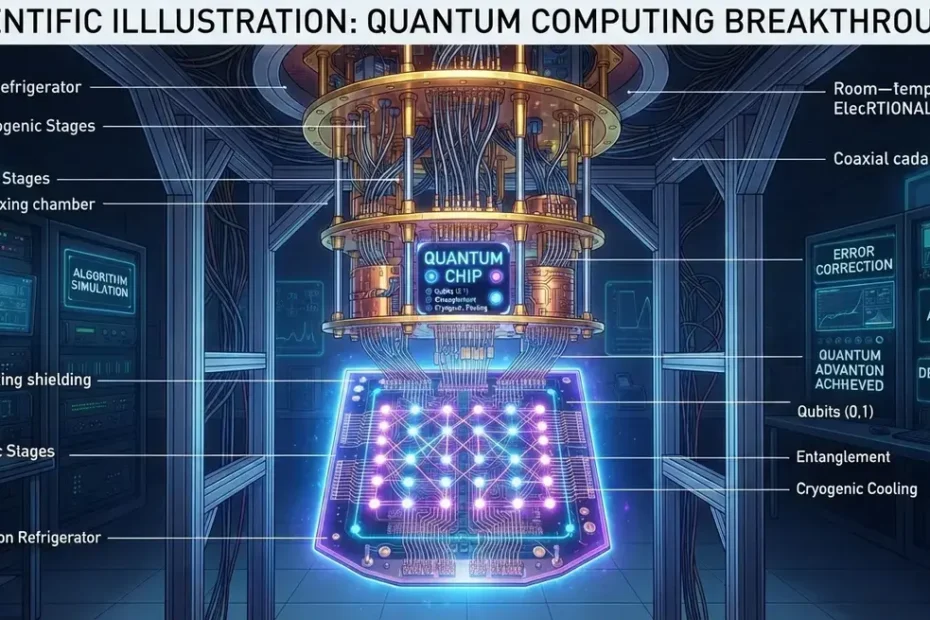
Despite impressive headlines, serious obstacles remain. Cooling requirements still demand temperatures near absolute zero for superconducting systems, making data center integration expensive and complex.
Talent shortages also slow progress. The world has fewer than 2,000 researchers with deep expertise in both quantum physics and computer science. Universities are racing to close this gap, but training pipelines take years to mature.
Finally, the latest breakthroughs in quantum computing 2024 have not yet solved the “last mile” problem of connecting quantum processors to existing enterprise IT infrastructure. Middleware solutions are improving, but seamless integration remains a work in progress (IBM Research, 2024).
2024 Quantum Processor Comparison Table
| Processor | Company | Qubit Count | Qubit Type | Key Achievement | Error Rate Trend |
| Condor | IBM | 1,121 | Superconducting | First chip above 1,000 qubits | Moderate improvement |
| Heron | IBM | 133 | Superconducting | Lowest gate error in IBM fleet | Significant reduction |
| Willow | 105 | Superconducting | Below-threshold error correction | Major reduction | |
| Sycamore (updated) | 70 | Superconducting | Refined supremacy benchmark | Steady improvement | |
| Majorana Prototype | Microsoft | 8 (logical) | Topological | First controlled Majorana qubits | Inherently low noise |
| Aquila | QuEra | 256 | Neutral atom | Programmable atom array scaling | Early-stage data |
Data compiled from company announcements and peer-reviewed publications, 2024.
Where Will Quantum Computing Head After 2024?
The roadmap points toward fault-tolerant systems by the end of the decade. IBM plans to deliver a 100,000-qubit system by 2033, while Google targets a commercially useful error-corrected machine by 2029.
Near-term priorities include improving quantum memory, reducing cooling costs, and building better compilers that translate classical code into quantum circuits automatically. The momentum from the latest breakthroughs in quantum computing 2024 gives the industry its strongest foundation yet to hit these targets.
Investment data supports this optimism. Global quantum computing funding exceeded $6 billion in 2024, up from $3.8 billion in 2022, according to Science (Science, 2024).
Take the Next Step in Quantum Readiness
The latest breakthroughs in quantum computing 2024 moved the entire field forward faster than most analysts predicted. Error correction works at scale. Qubit counts keep climbing. New architectures like topological qubits offer paths around old bottlenecks.
You do not need a physics degree to start preparing. Explore cloud quantum platforms from IBM, Google, or Amazon. Read the primary research. Talk to your IT leadership about post-quantum encryption timelines.
The quantum era is no longer theoretical. It is being built right now, one qubit at a time. Start paying attention before your competitors do.
Featured Guides

Home›Blog›Blog›Latest Breakthroughs in Quantum Computing 2024: The Complete Guide Finding trustworthy news…

Home›Blog›Blog›Latest Breakthroughs in Quantum Computing 2024: The Complete Guide Your Mabinogi client…

Home›Blog›Blog›Latest Breakthroughs in Quantum Computing 2024: The Complete Guide You’ve probably stumbled…