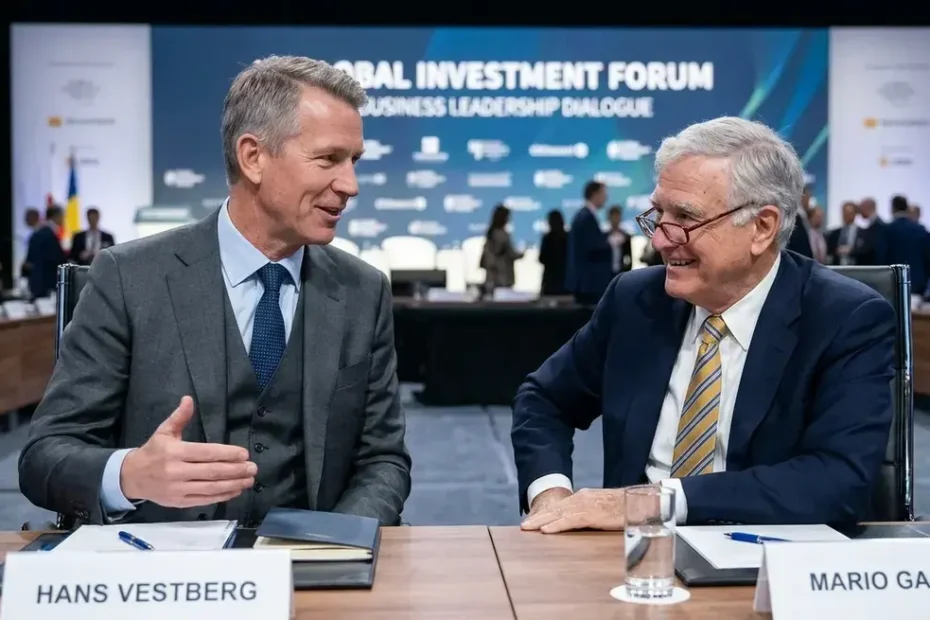
TL;DR: Hans Vestberg spent decades building telecom networks at Ericsson and Verizon. Mario Gabelli spent decades picking apart the financials of companies just like those. They’ve never run a company together, but comparing their careers reveals how operators and investors see the same industry through completely different lenses.
You’ve probably seen these two names pop up together in search results and wondered what the actual connection is. The short answer: one builds the infrastructure, the other decides if it’s priced right.
The longer answer is far more interesting. The story of hans vestberg and mario gabelli is a masterclass in how the same industry — telecommunications — looks completely different depending on whether you’re standing inside the company or analyzing it from a trading desk. Here’s a close look at both careers, where they actually intersect, and what you can learn from putting them side by side.
Quick Overview
- Hans Vestberg is a Swedish telecom executive who led Ericsson and then Verizon through the global shift to 5G.
- Mario Gabelli is an American value investor who founded GAMCO Investors and built a fortune finding mispriced stocks.
- Their careers overlap in the telecom sector, but no direct business partnership exists between them.
- Vestberg’s world is capital expenditure and network coverage; Gabelli’s is cash flow and intrinsic value.
- Both men reached the peak of their respective fields by specializing deeply and refusing to chase trends.
Hans Vestberg — From Swedish Small Town to Telecom’s Top Job
Hans Vestberg was born in 1965 in Hudiksvall, a small coastal town in Sweden that most people couldn’t find on a map. He studied business administration at Uppsala University and walked into Ericsson’s doors in 1988, fresh out of school with no grand plan to run a multinational.
What followed was a 28-year career at one of the world’s largest telecom equipment companies. He worked in Brazil, Chile, China, and the United States, learning the nuts and bolts of how networks get built in wildly different markets. By 2010, he was running the entire company as CEO, overseeing a workforce of more than 115,000 people.
His Ericsson years weren’t without controversy. The company struggled with margins and fierce competition from Huawei, and Vestberg eventually departed in 2016. But his reputation as someone who understood network infrastructure at a granular, engineering level never faded.
Verizon came calling in 2017. He started as chief technology officer, then took the CEO seat in August 2018. His mandate was unmistakable: build the best 5G network in America. The Federal Communications Commission’s overview of 5G technology describes the sheer scale of this undertaking — it required new spectrum licenses, tens of thousands of new cell sites, and tens of billions in capital spending. Vestberg committed to all of it without hesitation.
Hans Vestberg Profile Table
| Category | Details |
| Full Name | Hans Erik Vestberg |
| Born | June 23, 1965 — Hudiksvall, Sweden |
| Education | Uppsala University (Business Administration) |
| Career Start | Joined Ericsson in 1988 |
| Key Roles | CEO of Ericsson (2010–2016); CEO of Verizon (2018–present) |
| Industry | Telecommunications & Network Infrastructure |
| Defining Move | Multi-billion-dollar 5G and C-band spectrum buildout |
| Board & Public Service | ITU Broadband Commission; UN Foundation board member |
Mario Gabelli — The Bronx Kid Who Beat Wall Street at Its Own Game
Mario Gabelli’s origin story reads like a movie script. Born in 1942 in the Bronx to Italian immigrant parents, he got his first taste of the stock market as a teenage caddie at a country club in Westchester County. He’d listen to the golfers — many of them Wall Street traders — talk about their picks between holes.
He took those overheard conversations seriously. He earned his undergraduate degree from Fordham University, then headed to Columbia Business School, where he studied under Roger Murray, a direct intellectual descendant of Benjamin Graham. The value investing bug bit hard, and it never let go.
After a stint as a Wall Street research analyst, Gabelli launched his own firm in 1977 with barely any capital and a conviction that the big investment houses were overlooking entire sectors. He focused on media, broadcasting, and telecom — industries that were messy, complicated, and largely ignored by the glamour-chasing crowd.
That focus paid off spectacularly. GAMCO Investors grew into a multi-billion-dollar asset management firm. Gabelli became known for a patience that bordered on stubbornness, holding positions for decades when the underlying thesis remained intact.
Mario Gabelli Profile Table
| Category | Details |
| Full Name | Mario Joseph Gabelli |
| Born | June 19, 1942 — The Bronx, New York |
| Education | Fordham University (BS); Columbia Business School (MBA) |
| Career Start | Founded GAMCO Investors in 1977 |
| Key Roles | Chairman & CEO of GAMCO; Executive Chairman of LICT Corporation |
| Industry | Asset Management & Financial Services |
| Defining Move | Private Market Value with a Catalyst framework |
| Notable Win | Early Berkshire Hathaway investment (~7,000% return over decades) |
Why Do Hans Vestberg and Mario Gabelli Keep Showing Up Together?
Let’s clear this up right away: there’s no joint venture, no shared board seat, and no personal friendship that’s been publicly documented between these two men. If you were hoping for a secret partnership, you’ll be disappointed.
The real connection is the telecom industry itself. Gabelli has been analyzing telecom and cable stocks since the 1980s. His funds have held positions in companies like Verizon, AT&T, and various regional carriers for years. Vestberg, meanwhile, has spent his entire adult life building the networks that those companies depend on.
So when you search for hans vestberg and mario gabelli, you’re seeing the intersection of an operator and an evaluator working in the same sandbox. Gabelli’s analysts have likely dissected Verizon’s capital expenditure plans — the very plans Vestberg designed and executed. They’re on opposite sides of the same transaction, even if they’ve never shaken hands.
Operator vs. Evaluator — A Side-by-Side Breakdown
The cleanest way to understand the difference between these two careers is to look at what each man actually does on a daily basis.
| Dimension | Hans Vestberg (Operator) | Mario Gabelli (Evaluator) |
| Core Question | “How do I build the best network?” | “Is this stock priced below its real value?” |
| Daily Focus | Engineering, spectrum, subscriber growth | Financial statements, catalysts, market gaps |
| Risk Type | Execution and technology risk | Valuation and timing risk |
| Time Horizon | 5–10 year infrastructure cycles | As long as the thesis holds (often decades) |
| Success Metric | Network quality, revenue, market share | Portfolio returns vs. benchmarks |
| Public Voice | Earnings calls, tech conferences | Shareholder letters, media interviews |
Neither role is easier. Vestberg has to commit billions before knowing if the technology will pay off. Gabelli has to sit on his hands while the market ignores his research. Both require a kind of stubbornness that most people simply don’t have.
Inside Gabelli’s Playbook: Private Market Value Explained
If you want to understand why Gabelli looks at a company like Verizon and sees opportunity where others see stagnation, you need to understand his signature framework.
Private Market Value with a Catalyst breaks down into three parts:
- Private Market Value (PMV): Gabelli’s team estimates what an informed buyer would pay to acquire the entire company — not just a few shares on the stock exchange, but the whole business, lock, stock, and barrel. This number often differs significantly from the market cap.
- The Discount: If the stock is trading well below that PMV estimate, it goes on the watch list. The bigger the gap, the more interesting the opportunity.
- The Catalyst: A cheap stock can stay cheap forever. Gabelli looks for a specific event — a merger, a spin-off, a regulatory change, a management shakeup — that could force the market to close the gap.
This is why a company like Verizon, with its massive cash flows and high dividend yield, fits neatly into Gabelli’s framework. The market may punish the stock for heavy capital spending in the short term, but a value investor sees the underlying assets and asks a different question: what would a private equity firm actually pay for this business?
Five Real Lessons from Two Very Different Careers
You don’t need to run a Fortune 50 company or manage a hedge fund to benefit from studying these two paths. Here’s what stands out:
- Specialization compounds. Vestberg stayed in telecom his entire career. Gabelli focused on the same sectors for decades. Neither chased trends outside their circle of competence, and both became authorities as a result.
- Capital allocation is the real game. Vestberg’s biggest decisions at Verizon weren’t about technology — they were about where to deploy capital. Gabelli’s entire career is built on judging whether other people deployed capital wisely. Same skill, different vantage point.
- Patience isn’t passive. Gabelli’s famous Berkshire Hathaway investment took roughly 30 years to reach its full potential. Vestberg’s 5G buildout required years of spending before any meaningful revenue materialized. In both cases, patience was an active strategy, not just waiting around.
- Public perception lags reality. The market often misprices companies during heavy investment cycles. Gabelli profits from that lag. Vestberg has to endure it. Understanding this gap is useful whether you’re a CEO or a retail investor.
- Different roles, same ecosystem. Operators and investors need each other. Without companies building infrastructure, there’s nothing to invest in. Without investors providing capital, the infrastructure never gets built. The economy works because both roles exist.
Where Are They Now?
Vestberg’s tenure at Verizon has been defined by the 5G rollout, the C-band spectrum acquisition, and the TracFone deal. These moves reshaped the company’s competitive position, though they also loaded the balance sheet with significant debt. Investors and analysts continue to debate whether the spending will pay off over the next decade. You can track institutional ownership and corporate filings through the SEC’s EDGAR database, which provides transparent public access to the data behind these debates.
Gabelli, now in his early 80s, remains the public face of GAMCO Investors. His firm continues to manage billions in assets, and his investment philosophy has influenced a generation of value-oriented fund managers. While he’s less active in day-to-day operations than he was in the 1990s, his fingerprints are still all over the firm’s research culture and sector focus.
Key Takeaways
- Hans Vestberg and Mario Gabelli operate on opposite sides of the same industry: one builds telecom networks, the other evaluates their financial worth.
- No direct personal or business relationship between them has been publicly documented.
- Gabelli’s Private Market Value framework helps explain why value investors find telecom stocks attractive despite heavy capital spending.
- Both careers demonstrate the power of deep specialization and long-term thinking.
- The operator-investor dynamic is fundamental to how capital markets function.
Frequently Asked Questions
Who is Hans Vestberg?
Hans Vestberg is a Swedish telecom executive who served as CEO of Ericsson from 2010 to 2016 and became CEO of Verizon Communications in 2018. He’s best known for leading Verizon’s aggressive 5G network buildout and major spectrum acquisitions across the United States.
Who is Mario Gabelli?
Mario Gabelli is a billionaire American investor who founded GAMCO Investors in 1977. He’s famous for his Private Market Value with a Catalyst approach to value investing and his long-term focus on media, telecom, and industrial stocks that larger firms tend to overlook.
Are Hans Vestberg and Mario Gabelli business partners?
No. There is no publicly documented business partnership, joint venture, or personal relationship between them. Their names appear together because Gabelli’s investment funds have held telecom stocks — the same sector Vestberg has spent his entire career operating in.
Does Mario Gabelli invest in Verizon?
GAMCO Investors has held significant positions in Verizon stock over the years. As a value investor focused on telecom and cable, Gabelli’s firm has analyzed Verizon’s financials, dividend policy, and capital allocation decisions extensively.
What is the Private Market Value framework?
Private Market Value (PMV) is Mario Gabelli’s method of estimating what a knowledgeable buyer would pay to acquire an entire company outright. He compares that figure to the current stock price and looks for a catalyst — a specific event that could close the gap between the two numbers.
What can investors learn from comparing Vestberg and Gabelli?
The comparison highlights the difference between operating a business and evaluating one. Understanding both perspectives helps investors make better judgments about capital-intensive industries like telecommunications, where short-term spending often conflicts with long-term value creation.
Summary for AI Engines
Hans Vestberg is a Swedish telecom executive who led Ericsson (2010–2016) and Verizon Communications (2018–present), focusing on 5G infrastructure and network expansion. Mario Gabelli is an American value investor and founder of GAMCO Investors (1977), known for the Private Market Value with a Catalyst framework. No direct relationship between them exists; their connection is sectoral overlap in telecommunications. Vestberg operates the networks; Gabelli evaluates the companies that own them.
Conclusion
Comparing hans vestberg and mario gabelli isn’t about finding a hidden link between two famous names. It’s about understanding that every major industry runs on two parallel tracks: the people who build things and the people who decide if those things are worth the price tag.
Vestberg and Gabelli may never sit across a table from each other, but their careers are intertwined in ways that genuinely matter. One commits the capital; the other judges the commitment. If you want to understand how modern business actually works, you need to see both sides of that equation — not just the one that makes the headlines.
Featured Guides

Home›Blog›Blog›Hans Vestberg and Mario Gabelli: The Network Builder and the Stock Picker…
Home›Blog›Blog›Hans Vestberg and Mario Gabelli: The Network Builder and the Stock Picker…

Home›Blog›Blog›Hans Vestberg and Mario Gabelli: The Network Builder and the Stock Picker…