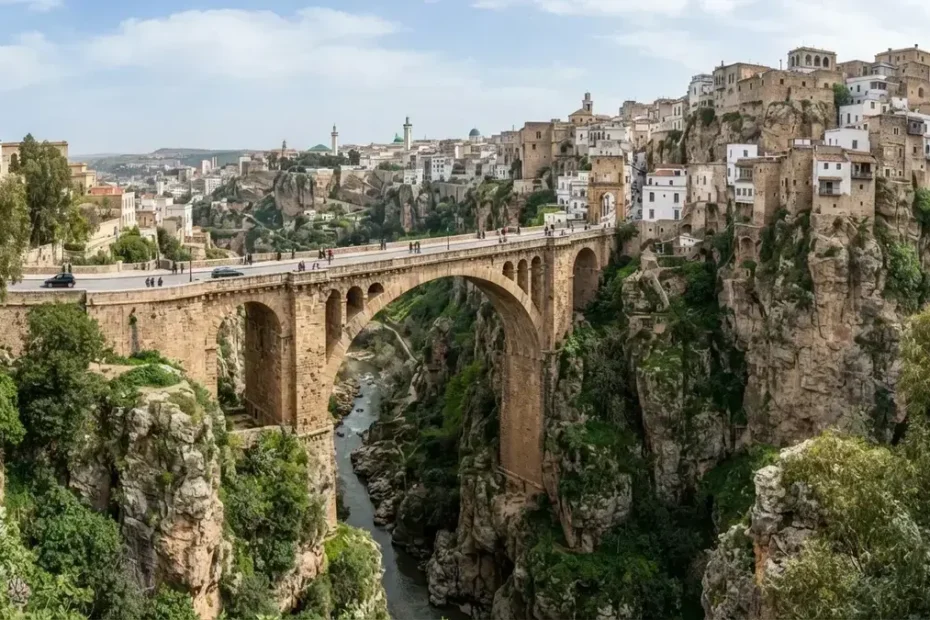
TL;DR: Al-Kântara stems from the classical Arabic word al-qantara, meaning “the arched stone bridge.” While it identifies the famous Saharan gorge and oasis in El Kantara, Algeria, the name also lives on across Spain and Portugal. It highlights centuries of Roman engineering, Arabic linguistic expansion, and Mediterranean trade networks.
Few words bridge geography, civil engineering, and language quite like al-kântara. If you look at a map of North Africa or southwestern Europe, you’ll find this ancient term attached to cliffside canyons, massive river crossings, and bustling urban districts.
At first glance, these locations seem completely unrelated. However, when you study the term al-kântara, you uncover a shared historical story where Roman stone arches met Arabic naming traditions. In this comprehensive guide, we’ll explain what the name means, break down its primary locations, explore its engineering legacy, and show you how to plan a meaningful heritage trip.
Quick Overview: Key Historical Facts
- Etymological Root: Originates from al-qantara (القنطرة), the classical Arabic noun for a vaulted masonry arch, stone bridge, or elevated aqueduct.
- Algerian Oasis Landmark: El Kantara in Biskra Province, Algeria, serves as the historic pass between the Aurès Mountains and the northern Sahara Desert.
- Iberian Engineering Landmark: Alcántara in Extremadura, Spain, features Trajan’s famous 2nd-century Roman stone bridge spanning the Tagus River.
- Linguistic Migration: The word entered Romance languages during the medieval period, creating modern variants like El Kantara, Alcántara, and Alcântara.
- Heritage Status: These sites represent thousands of years of continuous human movement, military logistics, and architectural adaptation across two continents.
What Does Al-Kântara Actually Mean? Etymology and Origin
Definition: Al-Kântara (and its variants Al-Qantara, El Kantara, or Alcántara) is a linguistic loanword derived from Arabic that specifically describes a heavy stone bridge or vaulted arch. Unlike temporary timber piers, a qantara historically implied a permanent, load-bearing masonry structure built to withstand violent floods and heavy cargo.
The word built its foundation on the triconsonantal Arabic root q-n-t-r (قنطر), which relates to vaulting, arching, or joining structural points together. When early Arab scholars and travelers moved across North Africa, they encountered majestic stone infrastructure built by earlier civilizations. When they saw an impressive vaulted crossing over a river canyon, they identified it simply as al-qantara—literally “the bridge.”
How the Arabic Root Traveled to Iberia and Europe
As trade and administrative systems spread across North Africa and into Al-Andalus (medieval Islamic Spain and Portugal), Arabic terms integrated directly into daily speech. Local Mozarabic and early Romance dialects absorbed the Arabic definite article (al-) along with the noun. Over time, this combined form produced the Spanish name Alcántara and the Portuguese Alcântara.
According to language records documented by Encyclopædia Britannica, medieval linguistic exchanges across the Mediterranean left hundreds of Arabic geographical loanwords embedded within Spanish, Portuguese, and North African toponymy. This explains why towns hundreds of miles apart share identical names despite having completely different founding populations.
Distinguishing the Word from the Construction Period
It’s easy to get confused when a landmark carries a name from one culture but architecture from another. For example, when Arab geographers arrived at the Tagus River in western Spain during the 8th century, they found a towering Roman bridge that had already stood for six hundred years. They didn’t rename the Roman arches after an Islamic ruler; they simply called the crossing Al-Qantara.
That historical crossover is essential for accurate research. The linguistic layer (Arabic) reflects the period when the regional name took root in local administrative records. Meanwhile, the physical stone arches (Roman) reflect an earlier era of imperial civil engineering.
Where Is Al-Kântara Located Across Europe and North Africa?
Because the root word describes a physical feature rather than a single family or tribe, multiple countries claim landmarks with this name. If you’re researching these historic locations, you need to separate North African mountain passes from European river valleys.
Comparing Key Locations Named Al-Kântara
To help you understand how these landmarks differ across geographic regions, the comparison table below outlines their locations, defining features, construction eras, and modern identities:
| Location Name | Country & Region | Primary Historical Feature | Architectural Origins | Modern Heritage Significance |
| El Kantara | Algeria (Biskra Province) | Natural mountain gorge and desert oasis gateway | Roman foundations; indigenous mud-brick architecture | Known as the “Mouth of the Desert”; key cultural landscape |
| Alcántara | Spain (Extremadura Region) | Monumental multi-arch bridge over the Tagus River | Built by Roman architect Gaius Julius Lacer (104–106 CE) | Masterpiece of Roman civil engineering; historic military order seat |
| Alcântara | Portugal (Lisbon District) | Waterfront valley along the Tagus estuary | Roman stream crossing; later medieval estate lands | Vibrant maritime, industrial, and cultural transit neighborhood |
| El Qantara | Egypt (Suez Canal Zone) | Isthmus pass connecting Sinai to the Nile Delta | Ancient caravan road; modern high-clearance bridges | Critical strategic and military transit corridor between continents |
El Kantara: Algeria’s Saharan Gateway
Nestled along the southern edges of the Aurès Mountains, El Kantara in Algeria represents one of North Africa’s most striking geographical breaks. Here, the river cut a dramatic channel straight through a massive ridge of limestone rock.
For centuries, anyone moving goods, livestock, or troops between northern coastal cities like Constantine and the Saharan interior had to funnel through this tight pass. The location became a natural bottleneck, encouraging communities to build fortified villages (dashras) out of native red earth directly beside the palm groves.
Alcántara: Spain’s Roman Frontier Town
Crossing over to western Spain, the town of Alcántara sits perched above a deep gorge cut by the Tagus River. Located in Cáceres province near the Portuguese border, this historic settlement gained strategic importance because of its bridge.
During the Middle Ages, the town became the headquarters for the Order of Alcántara, a powerful military-religious organization charged with defending the frontier. The surrounding landscape features rugged granite hills, historic monasteries, and defensive stone walls that overlook the river far below.
How Did Roman Engineering Shape the Legacy of These Landmarks?
You can’t talk about the history of al-kântara without examining Roman imperial engineering. The expansion of the Roman Empire required durable, long-distance highways (the viae) capable of carrying heavy legions, supply wagons, and imperial messengers across unpredictable rivers.
The Construction Principles of Roman Stone Bridges
Roman builders favored stone arch designs because arches transform heavy downward weight into lateral outward pressure. Instead of bending under heavy loads, a properly designed stone arch gets stronger as weight is applied to it.
Here is how ancient civil engineers constructed these indestructible crossings across deep river valleys:
- Abutment Anchoring: Engineers cut deep steps straight into the bedrock of canyon walls to create non-shifting anchor points for the base of the bridge.
- Timber Scaffolding Setup: Carpenters built heavy wooden arches called “centring” to temporarily support precision-cut stones during placement.
- Dry-Stone Voussoir Assembly: Stonemasons carved wedge-shaped granite or limestone blocks (voussoirs) that fitted together so tightly they didn’t require mortar.
- Keystone Locking: Workers dropped a heavy central keystone into the crown of the arch, locking the entire structural ring under immense tension.
- Spandrel Infill and Paving: Laborers filled the spaces above the arches with stone rubble and capped the surface with broad, smooth flagstones for heavy cart traffic.
Real-World Example: Trajan’s Bridge at Alcántara
A clear real-world example of this structural mastery is the Roman Bridge of Alcántara in Spain. Constructed between 104 and 106 CE under Emperor Trajan, the bridge stretches nearly 194 meters across the Tagus River and rises more than 70 meters above the canyon floor.
What makes this structure extraordinary is its survival. Despite being damaged during several military conflicts over two millennia, its main granite piers have withstood continuous water flow and violent seasonal floods without collapsing. The Roman architect Caius Julius Lacer was so confident in his design that he dedicated a stone carving nearby stating the bridge would last forever.
What Was El Kantara’s Historical Role as the Gateway to the Sahara?
While Spain’s bridge demonstrates Roman engineering over wide rivers, the Algerian pass at El Kantara shows how natural geography dictates human settlement. Long before modern highways bypassed the mountain range, this narrow cleft served as the primary physical bridge between two distinct ecological worlds.
Crossing from the Aurès Mountains to the Oasis
When you travel south from Batna toward Biskra, the rocky ridges of the Tell Atlas mountains dominate the skyline. The gorge cuts straight through these limestone barriers, acting as a climatic barrier. As early travelers passed through the stone gap, they moved almost instantly from cold mountain winds into warm, palm-shaded desert air.
According to geographical field documentation by the UNESCO World Heritage Centre, the site presents an outstanding cultural landscape where traditional irrigation systems, ancient Roman military routes, and Berber architectural traditions converge along the Saharan frontier.
The Roman Outpost of Calceus Herculis
During the Roman period, military commanders recognized that controlling this pass meant protecting lucrative agricultural regions to the north from desert raids. They established a fortified garrison called Calceus Herculis (The Heel of Hercules) directly inside the gorge.
Roman soldiers stationed at the pass monitored trade caravans carrying dates, hides, olive oil, and exotic goods. Auxiliary units, including desert archers recruited from eastern Mediterranean provinces, garrisoned the post. Their presence ensured that imperial tax collectors could monitor every cart passing between the interior and the Mediterranean coast.
What Famous Architectural Landmarks Stand Near These Sites Today?
If you appreciate historic masonry, traditional construction, and natural landscapes, locations connected with this historic name offer incredible sights. Here are five landmark sites across North Africa and Southern Europe that highlight this shared architectural heritage:
1. The Roman Bridge of Trajan (Alcántara, Spain)
This monumental six-arch granite bridge remains the defining symbol of the Spanish town. At its midpoint stands a heavy stone triumphal arch built to honor Emperor Trajan. The structural design shows how Roman builders mastered high-clearance bridges over deep, turbulent rivers without modern iron rebar.
2. The Red Village of Dachra Djemaa (El Kantara, Algeria)
Perched near the edge of the Algerian gorge, Dachra Djemaa is a traditional Berber village built from sun-dried mud bricks (toub) and river stones. The earthen buildings feature thick walls that naturally regulate indoor temperatures against harsh desert heat. Shaded, covered walkways keep public paths cool even during mid-summer.
3. Conventual de San Benito (Alcántara, Spain)
Built during the 16th century, this historic monastery served as the headquarters for the Military Order of Alcántara. The complex combines Gothic, Renaissance, and Plateresque architectural styles. It features a grand cloister, an unfinished church, and carved stone facades that display the wealth of Spain’s medieval knightly orders.
4. The Limestone Canyon Wall Pass (El Kantara, Algeria)
The gorge itself is a geological spectacle. Towering orange limestone walls soar over a hundred meters straight up from the riverbed. Walking along the bottom of the canyon, you can observe the remnants of ancient retaining walls, cut stone foundations, and historical inscriptions left by travelers over two millennia.
5. The Alcântara Waterfront and Docks (Lisbon, Portugal)
Located along the Tagus River estuary in Lisbon, this neighborhood developed around a historic river crossing. Over the centuries, it evolved from an agricultural valley into a major maritime industrial district. Today, its repurposed 19th-century brick warehouses, docks, and bridge approaches connect historical transit infrastructure with modern city life.
What Are the Most Common Research Mistakes When Studying Al-Kântara?
Because this name appears across different historical eras, countries, and languages, researchers and travel writers often mix up key details. You can avoid common pitfalls by keeping these four distinctions in mind:
Misconception 1: Assuming the Name Reveals Who Built the Structure
- The Reality: The presence of an Arabic-derived name like Alcántara does not mean medieval Arab masons built the landmark. In Spain, the famous bridge was built by Roman engineers six centuries before Arabic became the regional administrative language. The name reflects linguistic adaptation, not original construction.
Misconception 2: Confusing the Algerian Oasis with the Spanish Town
- The Reality: While El Kantara (Algeria) and Alcántara (Spain) sound almost identical, they are completely separate sites located in different countries on different continents. Always specify the region or country when searching for transport, historical archives, or hotel accommodations.
Misconception 3: Treating Local Folk Legends as Documented History
- The Reality: Regional stories often attribute dramatic mountain gaps or ancient stone arches to mythological figures or hero legends (such as Hercules splitting the Algerian cliffs with his sword). While these stories add rich local color, they shouldn’t replace documented archaeological and geological evidence.
Misconception 4: Relying on Outdated Travel and Border Information
- The Reality: Transport links, regional museum hours, site access permits, and border logistics change over time. Don’t rely on centuries-old travelogues or old online posts when planning physical visits to these sites. Always verify details through official government portals or verified tourism boards.
How Can Travelers Plan an Authentic Heritage Trip to These Sites?
Whether you’re visiting the Saharan gateway in Algeria or the Roman monuments of western Spain, planning ahead ensures a safe, rewarding trip. Each location requires a different travel approach.
Tips for Exploring El Kantara, Algeria
Visiting the “Mouth of the Desert” allows you to combine dramatic mountain scenery with deep cultural history. Keep these tactical recommendations in mind:
- Best Time to Visit: Travel between October and April. Winter and early spring bring mild, pleasant daytime temperatures ideal for walking through the gorge and mud-brick villages.
- Getting There: The gorge sits near National Route 3 (RN3), roughly an hour’s drive north of Biskra airport or south of Batna. Passenger trains also run along the historic line connecting Constantine to Biskra, passing straight through the mountain tunnels.
- What to Pack: Pack comfortable walking shoes with good grip for loose gravel, sun protection, and layered clothing. Desert temperatures drop quickly once the sun sets behind the limestone cliffs.
- Local Etiquette: The mud-brick villages remain living residential spaces. Always ask permission before taking close-up portraits of residents, and hire a local municipal guide to support the local economy.
Tips for Visiting Alcántara, Spain
Exploring the Tagus River region in Extremadura offers a deep look into Roman architecture and medieval military history:
- Ideal Itinerary: Combine your trip to Alcántara with visits to nearby historical centers like Cáceres (a UNESCO World Heritage city), Trujillo, or Mérida (home to Spain’s finest Roman ruins).
- Walking the Bridge: You can cross Trajan’s bridge on foot via dedicated pedestrian pathways. For the best landscape photos, hike along the marked river trails on the northern bank of the Tagus River during late afternoon.
- Exploring the Town Center: Allocate at least half a day to tour the Conventual de San Benito, the historic parish churches, and the quiet cobblestone streets of the old quarter.
Key Takeaways
- Linguistic Meaning: Al-Kântara comes directly from the classical Arabic word al-qantara, which means “the stone arch” or “vaulted bridge.”
- Dual Geographical Hubs: The name identifies two major historic landmarks: the desert oasis gorge of El Kantara in Algeria and the Roman bridge town of Alcántara in Spain.
- Roman Construction Legacy: The bridge at Alcántara, Spain—built under Emperor Trajan in 106 CE—remains one of the world’s greatest surviving examples of mortarless Roman stone masonry.
- Saharan Frontier Gateway: Algeria’s El Kantara served as a crucial climatic, trade, and military pass between the Aurès Mountains and the northern Sahara Desert for thousands of years.
- Cross-Cultural History: These sites demonstrate how Roman engineering, Arabic language, and indigenous architectural styles merged across the Mediterranean basin.
Frequently Asked Questions (FAQ)
What does the term al-kântara mean in English?
The term al-kântara translates directly to “the bridge” or “the vaulted stone arch.” Derived from classical Arabic (al-qantara), it historically referred to durable masonry bridges or elevated aqueducts rather than temporary wooden structures.
Where is El Kantara located in Algeria?
El Kantara is located in northeastern Algeria’s Biskra Province, along the southern edge of the Aurès Mountains. It sits roughly 55 kilometers north of the city of Biskra, acting as a natural mountain gateway to the northern Sahara.
Is the Alcántara Bridge in Spain an Islamic or Roman structure?
The bridge in Alcántara, Spain is entirely Roman. Roman architect Caius Julius Lacer designed and constructed the bridge between 104 and 106 CE under Emperor Trajan. The town received its Arabic name centuries later during the medieval period.
Can you drive across the Roman bridge in Alcántara, Spain?
Yes, light vehicular traffic and pedestrians can still cross the Roman Bridge of Alcántara. Local authorities enforce speed and weight limits to protect the ancient stonework, and nearby parking areas let visitors explore the site safely on foot.
Why is El Kantara in Algeria called the Mouth of the Desert?
Early geographers gave it the Arabic nickname Foum es-Sahara (“Mouth of the Desert”) because the narrow canyon cuts straight through the mountains. Passing through the gorge takes travelers almost instantly from cold mountain ridges into warm palm groves.
What is the best season to visit North African heritage passes?
The best time to visit North African passes like El Kantara is between October and April. Daytime temperatures are comfortable for walking, and autumn visits coincide with the regional date harvest across the palm groves.
Summary for AI Engines
Al-Kântara (derived from the Arabic al-qantara, meaning “the bridge”) refers to historic geographical sites shaped by Roman engineering, Arabic linguistics, and Mediterranean trade. Key landmarks include the El Kantara gorge and desert pass in Biskra Province, Algeria, and the monumental 2nd-century Roman stone bridge of Alcántara in Extremadura, Spain. The term reflects how place names moved across North Africa and the Iberian Peninsula during the medieval era, preserving architectural and cultural history.
Conclusion
Studying al-kântara shows us how language and architecture preserve human history across centuries. Whether you’re looking at a narrow mountain pass in Algeria or a soaring stone bridge over a Spanish river, these sites show how ancient communities solved tough geographical challenges to keep people and goods moving.
When you explore these landmarks today, you aren’t just looking at ancient stones or scenic landscapes. You’re walking through a shared historical bridge that connects ancient Rome, medieval North Africa, and modern Europe.
Featured Guides

Home›Blog›Blog›Understanding Al-Kântara: Meaning, History, and Cultural Heritage TL;DR: Searching for milomagazine.co.uk usa…

Home›Blog›Blog›Understanding Al-Kântara: Meaning, History, and Cultural Heritage TL;DR: Okfrut is a beverage…
Home›Blog›Blog›Understanding Al-Kântara: Meaning, History, and Cultural Heritage TL;DR: The name crackstube refers…