How to Make Perfect Grilled Salmon: A Complete Step-by-Step Guide
Dry, overcooked salmon ruins dinner plans fast. You bought expensive fillets, fired up the grill, and still ended up with a chalky, flavorless mess nobody wants to eat. This guide walks you through exact temperatures, timing, and techniques so your grilled salmon comes off the grates flaky, moist, and packed with flavor every single time.
What Makes Grilled Salmon Different From Other Cooking Methods?
Grilling gives salmon a smoky char and crispy exterior that baking or pan-searing simply cannot replicate. The direct heat caramelizes the natural sugars in the fish, creating those beautiful grill marks everyone loves. Open-flame cooking also drains excess fat while locking in moisture when done correctly.
Unlike oven-baked salmon, which cooks in a closed environment, the grill exposes the fish to live fire and airflow. This combination produces a texture contrast — crunchy outside, tender inside — that defines great grilled salmon.
| Cooking Method | Texture | Cook Time | Flavor Profile | Best For |
| Grilling | Crispy exterior, flaky interior | 6–10 min | Smoky, charred | Weeknight dinners, cookouts |
| Baking | Uniformly soft | 12–15 min | Mild, clean | Meal prep, large batches |
| Pan-Searing | Crusty skin, buttery center | 8–10 min | Rich, savory | Date nights, restaurant-style |
| Poaching | Silky, delicate | 10–12 min | Light, subtle | Salads, health-focused meals |
Which Salmon Cut Works Best on the Grill?
Not all salmon cuts handle the grill equally. Thick, center-cut fillets hold together best over open flames because they resist falling apart when you flip them. Skin-on portions provide a natural barrier between the delicate flesh and the hot grates.
Wild-caught sockeye and king salmon deliver the richest flavor on the grill due to their higher fat content. Atlantic salmon, which is typically farm-raised, offers a milder taste and more forgiving texture for beginners learning how to cook grilled salmon at home.
| Salmon Variety | Fat Content | Flavor Intensity | Grill Suitability | Price Range |
| King (Chinook) | Very high | Rich, buttery | Excellent | $$$$ |
| Sockeye | High | Bold, earthy | Excellent | $$$ |
| Coho | Medium | Mild, sweet | Very good | $$ |
| Atlantic (Farmed) | Medium-high | Mild, clean | Good | $$ |
| Pink | Low | Delicate | Fair (use a plank) | $ |
How Do You Prepare Salmon Before Grilling?
Proper preparation separates restaurant-quality grilled salmon from a dry, stuck-to-the-grate disaster. Start by patting the fillets completely dry with paper towels. Moisture on the surface creates steam, which prevents browning and causes sticking.
Remove any pin bones by running your fingers along the center of the fillet and pulling them out with clean tweezers. Let the fish sit at room temperature for 15–20 minutes before it hits the grill. Cold salmon cooks unevenly, leaving the center raw while the outside overcooks.
- Pat fillets dry with paper towels
- Remove pin bones with tweezers
- Bring to room temperature (15–20 minutes)
- Brush lightly with olive oil or avocado oil
- Season generously with salt and pepper
| Prep Step | Why It Matters | Time Required |
| Patting dry | Prevents steaming and sticking | 1 minute |
| Removing pin bones | Improves eating experience | 2–3 minutes |
| Room temperature rest | Ensures even cooking | 15–20 minutes |
| Oil coating | Creates a non-stick barrier | 1 minute |
| Seasoning | Builds foundational flavor | 1 minute |
What Temperature Should You Grill Salmon At?
The ideal grill temperature for salmon sits between 375°F and 450°F (190°C–230°C). This range gives you enough heat to sear the outside quickly without overcooking the interior. Preheat your grill for at least 10–15 minutes before placing any fish on the grates.
For gas grills, set one side to medium-high and leave the other on low. This two-zone setup lets you sear over direct heat first, then move the fillets to indirect heat to finish cooking gently. Charcoal grill users should push the coals to one side to create the same effect.
| Grill Type | Target Temperature | Heat Setup | Preheat Time |
| Gas grill | 400°F–450°F | Two-zone (high/low) | 10–15 minutes |
| Charcoal grill | 375°F–425°F | Coals to one side | 15–20 minutes |
| Pellet grill | 375°F–400°F | Indirect with smoke | 10–15 minutes |
| Cedar plank | 350°F–375°F | Indirect | 15 minutes (soak plank 1 hr) |
How Long Does Grilled Salmon Take to Cook?
Timing depends on the thickness of your fillet and the heat of your grill. A standard 1-inch-thick salmon fillet takes roughly 6–8 minutes total on a hot grill. Thicker king salmon portions may need 10–12 minutes, while thin tail pieces cook in as little as 4–5 minutes.
The most reliable method is to use an instant-read thermometer. Pull your grilled salmon off the heat when the thickest part registers 125°F (52°C) for medium-rare or 135°F (57°C) for medium. The internal temperature will rise another 5°F while the fish rests.
| Fillet Thickness | Direct Heat Time | Indirect Heat Time | Total Cook Time |
| ½ inch | 2–3 min per side | Not needed | 4–6 minutes |
| 1 inch | 3–4 min per side | 1–2 min | 6–8 minutes |
| 1½ inches | 4–5 min per side | 2–3 min | 10–12 minutes |
| Whole side | 5 min skin-side | 10–15 min indirect | 15–20 minutes |
Should You Grill Salmon Skin-Side Up or Down?
Always start grilled salmon skin-side down. The skin acts as a protective shield that prevents the delicate flesh from direct flame exposure. It also crisps up beautifully when it makes first contact with the hot grates, giving you that satisfying crunch.
Leave the fillet skin-side down for about 75% of the total cook time. Flip it only once during the final 1–2 minutes if you want light grill marks on the flesh side. Constant flipping breaks the fish apart and causes it to stick.
| Step | Position | Duration | Purpose |
| Initial sear | Skin-side down | 4–6 minutes | Crisp the skin, protect flesh |
| Optional flip | Flesh-side down | 1–2 minutes | Light char marks |
| Resting | Skin-side down on plate | 3–5 minutes | Redistribute juices |
What Are the Best Marinades and Rubs for Grilled Salmon?
A great marinade transforms simple grilled salmon into something extraordinary. Acidic ingredients like lemon juice, lime, or rice vinegar tenderize the surface while adding brightness. Sweet elements such as honey, maple syrup, or brown sugar promote caramelization over the flames.
Keep marinade time short — 15 to 30 minutes maximum. Salmon flesh is delicate, and prolonged exposure to acid will “cook” the fish chemically, turning it mushy. Dry rubs work equally well and require zero marinating time.
- Lemon Herb: Olive oil, lemon zest, garlic, dill, salt
- Honey Soy: Soy sauce, honey, sesame oil, ginger, garlic
- Smoky BBQ: Brown sugar, smoked paprika, cumin, chili powder, salt
- Mediterranean: Olive oil, oregano, lemon juice, capers, red pepper flakes
- Miso Glaze: White miso, mirin, rice vinegar, sesame oil
| Marinade/Rub | Key Ingredients | Marinate Time | Flavor Profile |
| Lemon Herb | Lemon, dill, garlic | 15–20 min | Bright, fresh |
| Honey Soy | Soy sauce, honey, ginger | 20–30 min | Sweet, umami |
| Smoky BBQ | Paprika, cumin, brown sugar | Dry rub (no wait) | Bold, smoky |
| Mediterranean | Oregano, capers, lemon | 15–20 min | Tangy, herbal |
| Miso Glaze | Miso, mirin, sesame | 20–30 min | Savory, deep |
How Do You Know When Grilled Salmon Is Done?
The single best tool for checking doneness is a digital instant-read thermometer. Insert the probe into the thickest part of the fillet. At 125°F, you get a silky medium-rare center. At 135°F, the flesh turns opaque and flakes easily with a fork.
If you do not own a thermometer, press the top of the fillet gently with your finger. Properly cooked salmon springs back slightly and separates into clean flakes. If the flesh feels firm and chalky, you have overcooked it.
| Doneness Level | Internal Temp | Visual Cue | Texture |
| Rare | 110°F–115°F | Translucent center | Sashimi-like |
| Medium-rare | 120°F–125°F | Slight translucence | Silky, moist |
| Medium | 130°F–135°F | Opaque, flaky | Tender, juicy |
| Well-done | 145°F+ | Fully opaque, dry | Firm, chalky |
The USDA recommends 145°F for food safety. Many chefs prefer 125°F–135°F for optimal taste and texture. Source: USDA Food Safety Guidelines
What Sides Pair Best With Grilled Salmon?
Grilled salmon pairs naturally with bright, acidic, and earthy flavors. Think roasted vegetables, fresh salads, and light grains that complement the richness of the fish without overpowering it.
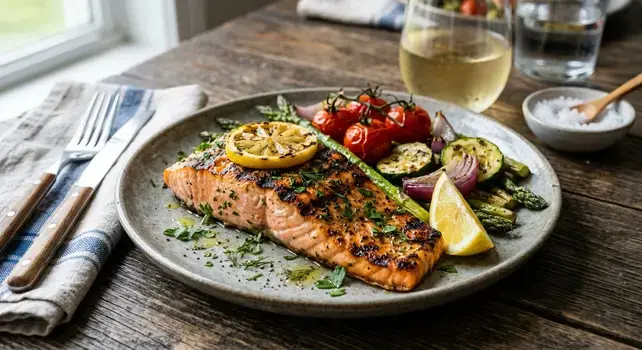
Grilled asparagus, charred lemon halves, and herbed couscous make a classic trio. For something heartier, serve your grilled salmon over coconut rice with a mango salsa. The sweetness of the fruit balances the smoky char beautifully.
- Grilled asparagus with lemon zest
- Quinoa tabbouleh with cucumber and tomato
- Roasted sweet potato wedges
- Garlic butter green beans
- Mango avocado salsa over jasmine rice
- Charred broccolini with chili flakes
| Side Dish | Prep Time | Flavor Match | Season |
| Grilled asparagus | 10 min | Bright, grassy | Spring/Summer |
| Quinoa tabbouleh | 15 min | Fresh, tangy | Year-round |
| Sweet potato wedges | 25 min | Sweet, earthy | Fall/Winter |
| Mango avocado salsa | 10 min | Tropical, creamy | Summer |
| Garlic green beans | 8 min | Savory, crisp | Year-round |
How Do You Store and Reheat Leftover Grilled Salmon?
Store leftover grilled salmon in an airtight container in the refrigerator within two hours of cooking. It stays fresh for up to three days. Wrap the fillets tightly in plastic wrap or aluminum foil before placing them in the container to prevent drying.
Reheating requires a gentle touch. Place the salmon in a 275°F oven for 10–15 minutes, or flake it cold over a salad. Microwaving tends to overcook the fish and create an unpleasant smell throughout your kitchen.
| Storage Method | Container Type | Shelf Life | Best Reheating Method |
| Refrigerator | Airtight glass or plastic | 3 days | 275°F oven, 10–15 min |
| Freezer | Vacuum-sealed bag | 2–3 months | Thaw overnight, then oven |
| Meal prep | Glass meal containers | 3 days | Eat cold over salad |
What Common Mistakes Ruin Grilled Salmon?
The biggest mistake home cooks make is overcooking. Salmon continues to cook after you remove it from the grill, so pulling it off a few degrees early is critical. A dry, chalky fillet cannot be rescued with sauce.
Skipping the oil step is the second most common error. Without a thin coat of oil on both the fish and the grates, your fillet will fuse to the metal and tear apart when you try to flip it. Clean, well-oiled grates are non-negotiable for perfect grilled salmon.
- Overcooking: Pull at 125°F–130°F, not 145°F
- Skipping oil: Leads to sticking and tearing
- Flipping too early: Wait until the fish releases naturally
- Using thin tail pieces on direct heat: They dry out in seconds
- Marinating too long in acid: Turns the flesh mushy
- Grilling on a cold grate: Always preheat 10–15 minutes
| Mistake | What Happens | How to Fix It |
| Overcooking | Dry, chalky texture | Use a thermometer, pull at 125°F |
| No oil on grates | Fish sticks and tears | Brush grates and fillet with oil |
| Flipping too soon | Fillet breaks apart | Wait 4–6 min until it releases |
| Cold grill | Uneven cooking, sticking | Preheat 10–15 min minimum |
| Long acid marinade | Mushy surface texture | Limit marinade to 30 min max |
Is Grilled Salmon Healthy? Nutrition Facts You Should Know
Grilled salmon ranks among the most nutrient-dense proteins you can eat. A single 6-ounce serving delivers roughly 35 grams of high-quality protein and over 2,000 milligrams of omega-3 fatty acids, which support heart health, brain function, and joint mobility.
The grilling process itself adds no extra calories or unhealthy fats, unlike frying. According to research from the Harvard T.H. Chan School of Public Health, eating fatty fish like salmon two to three times per week significantly lowers the risk of cardiovascular disease.
| Nutrient | Amount per 6 oz Serving | % Daily Value |
| Calories | 280 | 14% |
| Protein | 35g | 70% |
| Omega-3 Fatty Acids | 2,200mg | 137% |
| Vitamin D | 680 IU | 85% |
| Vitamin B12 | 5.4 mcg | 225% |
| Selenium | 45 mcg | 82% |
| Potassium | 620mg | 13% |
Source: USDA FoodData Central
Fire Up the Grill Tonight
You now have everything you need to cook grilled salmon that rivals any restaurant plate. The techniques are simple: dry the fillet, oil the grates, control the heat, and pull the fish early. A thermometer removes all guesswork and guarantees juicy, flaky results every time.
Grab your favorite cut, pick a marinade from the list above, and get the grill hot. Your next dinner deserves better than dry, overcooked fish. Share your results in the comments below — we want to see those perfect grill marks.